
Particle Physics and The Standard Model


Particle physics is the science that studies the nature of subatomic particles which form our universe, which addresses us to the question what is matter made up of. It shows that particles are produced due to particles collisions which are classifies into three families. These particles form the molecules and atoms with the help of four basic forces. The Standard Model describes strong, weak, and electromagnetic forces, using the gauge bosons. Types of gauge bosons are the gluons, W-, W + and Z bosons, and photons. The standard model also contains 24 fundamental particles 12 particles and their associated anti-particle, which are the components of all matter. Finally, the standard model predicted the existence of a type of boson known as the Higgs boson. On July 4, 2012, physicists announced with the Large Hadron Collider at CERN they have found a new particle that behaves like what is expected of the Higgs boson.
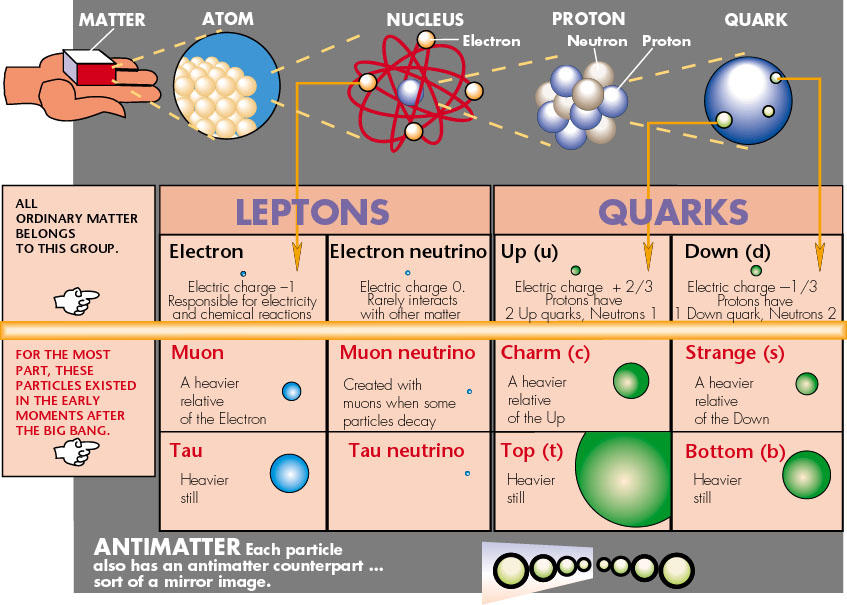
 
Image result for the Standard model

Comments

Popular posts from this blog

What is physics??

What is physics? The dictionary definition of physics is "the study of matter, energy, and the interaction between them", but that really means is that physics is about asking fundamental questions and trying to answer them by observing and experimenting. physicists ask really big questions like: how did the universe begin? how will the universe change in the future? how does the sun keep on shining?  what are the basic building blocks of matter? If you thi nk these questions are fascinating, then you'll like physics!  Physics is the knowledge of nature, which is the natural science that studies matter and its motion and behavior through space and time and that studies the related entities of energy and force. Physics is one of the most fundamental scientific disciplines, and its main goal is to understand how the universe behaves!

attending educational media and technology courses

It is my pleasure to attend such course in the spring semester. This course is full of beneficial information that make us more accessible to computer applications and programs. It makes our work more easier as teachers. From the beginning of the semester the classes are going fluently and everything seems to be fine. I am waiting for having more ideas about using computers to facilitate our job. 

Dyslexia

What every Teacher needs to know about DYSLEXIA? Children with dyslexia suffer in reading, spelling and / or speaking. The degree of suffering varies from one individual to another based on the type of teaching the person receives and on the inherited differences in brain development.  Characteristics of Dyslexia: Difficulties with accurate word recognition. Poor spelling. Problems in reading comprehension. Reduced reading experience. Symptoms and signs of Dyslexia:   Difficulty in remembering simple sequences, such as: counting to 20, naming the days of the week.   Difficulty in understanding the rhyming of words, such as: fat and cat Pronunciation difficulties. Trouble in remembering names of places and people. Difficulty in remembering spoken directions. Causes of having Dyslexia:   Neuroanatomy (neurological aspect).   Genes and Heredity. Gene-Environment. how to deal with dyslexic students: T aping lectures rather t...